

There are fabrics we wear, and others we feel. Corduroy falls into the second category: that distinctive texture that catches the light, that reassuring thickness you feel the moment you slip it on, that subtle rustle as the fabric rubs against itself. Before becoming a wardrobe staple, corduroy was worn by English workers, Boy Scouts, and farmers—a fabric with a rich history, and you can feel it.
In France, the temperate climate means you can wear it for nearly 10 out of 12 months—only the two hottest months of summer really rule it out. The rest of the year, it’s a fabric just waiting to be worn.
What Makes Velvet So Special
It's no coincidence that corduroy has stood the test of time without ever really going out of style:
- A texture you won't find anywhere else —the ribs create depth, play with the light depending on the angle from which you view them, and give each piece a character that smooth cotton or denim simply don't have.
- A fabric that gets better with time —velvet develops a patina, becomes softer, and takes on a more lived-in look with every wash. Unlike many fabrics that wear out and lose their shape, velvet gains character.
- Natural warmth —without needing to be as thick as wool, ribbed fabric provides remarkable insulation against the cold.
- A timeless workwear aesthetic —drawn from workwear, velvet always retains that slightly raw and functional look, even on a refined piece.
The work jacket: the most-worn piece

Henry, the corduroy work jacket — made from French organic cotton corduroy with a wide rib (330 g/m²), crafted in the same cut as our iconic work jacket: straight, structured, with three patch pockets and a shirt collar that stays in place thanks to a collar stand. When draped over your shoulders, it’s a piece that instantly looks like it’s been through a lot—thrown over a wool sweater on a cool morning, or worn over a simple T-shirt on milder days.
The shirt: a texture that feels close to the skin
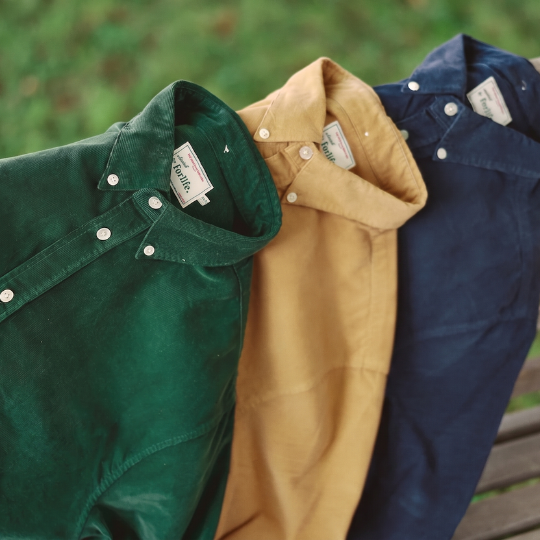
Louis, the velvet shirt (with or without a pocket)—in deep shades like cognac, dark green, or navy blue, this shirt has that little extra something that a classic cotton shirt lacks. Velvet against the skin is a unique sensation: more enveloping, more textured, almost comforting.

The overshirt: for layering with character
George, the velvet overshirt — a piece designed to be layered, to throw over a T-shirt or a lighter shirt when the temperature drops. It’s the one that adds the most presence to a simple outfit, without ever looking forced.

Velvet jeans: the same silhouette, a different look
Charles, the velvet jeans — cut exactly like classic jeans, but in a fabric that completely transforms the look of an outfit. This is the perfect choice for anyone who wants to refresh their style without changing their usual fit.

How to pair it
The simplest rule: wear only one velvet piece at a time. A velvet shirt with classic jeans, or a velvet work jacket over a T-shirt and solid-colored pants—but avoid combining multiple velvet pieces in the same outfit.
When it comes to colors, deep shades (dark green, cognac, navy blue) are the ones that best highlight the fabric: velvet already catches the eye with its texture, so there’s no need to overdo it with color.
One fabric, four silhouettes, the same reimagined workwear aesthetic—see the entire collection.


