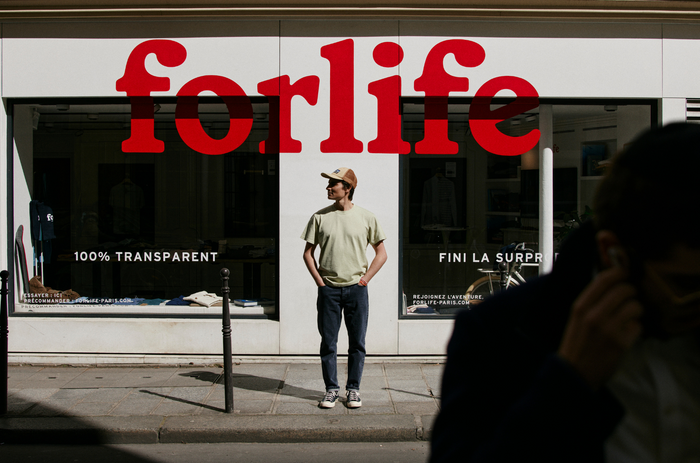


When Fast Fashion Takes Root in the Heart of Paris
It’s official: SHEIN has just opened a pop-up shop at BHV.
Yes, SHEIN.
The champion of disposable fashion—clothes produced on the other side of the world, delivered in 24 hours, and worn… sometimes for even less time than that.
It’s a powerful symbol.
A historic Parisian department store, which has seen decades and trends come and go, now hosts the world’s most controversial brand.
It’s as if someone had set up a fast-food restaurant in the middle of an organic market: a bit absurd, but above all, indicative of the times.
What if, instead of crying foul, we took this moment to think about what we really put into a T-shirt?
The T-shirt: From Workers’ Underwear to a Universal Icon
The T-shirt hasn't always been that ordinary staple we pile up in our drawers.
Originally, it was a pair of work underwear, which appeared in the early 20th century.
Then American soldiers adopted it as part of their uniform.
And one day, Marlon Brando put it on in A Streetcar Named Desire (1951).
The result: the T-shirt has become a symbol.
Of rebellion, freedom, and authenticity.
That's all there is to it.
Since then, it’s been everywhere.
And that may be where the problem began: the simplest garment in the world has become the most mass-produced, the most discarded, and the most forgotten.
A few eye-opening figures:
-
2 billion T-shirts are sold worldwide each year.
-
Some cost less than €3 each.
-
In 1960, 95% were manufactured in the United States.
Today, 85% come from Asia. -
Most have an average lifespan of… 35 washes.
- The world's most expensive T-shirt is a Hermès, and it costs 70,000 euros (who cares, but still!)
At forlife, we asked ourselves: What if we went back to basics?
Marlon: Our T-shirt, Our Manifesto
Marlon is the very first product we launched.
The T-shirt that symbolizes everything we wanted to stand for with forlife: common sense.
No new collections every month.
No ridiculous sales.
No leftover inventory that ends up on clearance.
Just a well-made T-shirt at a fair price, produced under fair conditions, that you can keep for years.
Its design? Timeless.
Its cotton? Organic, knitted in Portugal.
Its price? Fair.
And most importantly: it’s not produced until it’s ordered.
The result: zero waste, zero sales, zero greenwashing.
Since 2018, Marlon has won over more than 15,000 customers.
And many of them are still writing to us:
“I’ve had it for four years, and it hasn’t changed a bit.”
“It’s my favorite T-shirt—the one I put on without even thinking.”
That’s our greatest reward.
And our strongest argument against fast fashion.
![]()

"We just wanted to make honest clothing."
— Lucas & Séverin Bonnichon, founders of forlife
Why did you start with a T-shirt?
Because it’s the most universal piece of clothing—the one we wear every day.
If we couldn’t make the perfect T-shirt, there was no reason to go any further.
What annoys you the most about fast fashion?
The lies.
They make it seem like a piece of clothing can cost €5, with no consequences.
But there’s always someone, somewhere, who pays the price: a worker, the planet, or quality.
So what exactly is forlife?
It’s a way of doing things on a human scale, respecting people and allowing the time needed to do things right.
We don’t promise perfection, but we promise to try to do things right.
The True Price of a T-Shirt
A T-shirt for €5 is like a baguette for 10 centimes: something's not right.
A Marlon for €29 (pre-order) is:
-
5 € for raw materials and knitting in Portugal
-
€4.50 for production in a family-run workshop
-
€1.50 for labels and packaging
-
€6 in taxes
-
A gross margin of 12 €, which allows Forlife to operate (and develop new products)
And most importantly: no overproduction, no inventory to clear out, no sales to make up for.
Each T-shirt is made to order.
That's all.
Nothing less.
Marlon and his crew: Rick, Matt, Max
Marlon's organic cotton has spawned new varieties:
-
Rick, the button-down Henley (the dressier version of the Marlon)
-
Matt, the long-sleeve version for cooler seasons
-
Max, the oversized T-shirt for fans of loose fits
All knitted from the same material.
All made in the same place.
All designed to last.
A cohesive wardrobe, not an endless collection.


Our customers say it better than we do
“I’ve been wearing the same Marlon for 5 years. It’s starting to develop a nice patina, just like a pair of jeans.”
“I gave it to my brother, and he asked me where I’d found it… then he bought three more.”
“What I love is that I know who made it and why.”
At forlife, we don't use models.
We feature real people who actually wear our clothes.
And that's all we ever wanted.
Buy Less, But Better (and with Purpose)
SHEIN can open stores all over the world, but that won't change one simple fact:
True sustainable fashion is the kind you keep.
Every Marlon T-shirt is made-to-order by Portuguese artisans, guided by a simple philosophy: quality, transparency, and durability.
This Friday, we're relaunching pre-orders for the Marlon.
Delivery expected in February.
Still made from the same organic cotton.
Still made in Portugal.
Still the same promise:
To give you the T-shirt you'll keep the longest in your life.
We might not change the world with a T-shirt.
But we can start by changing the way it’s made.


Leave a comment